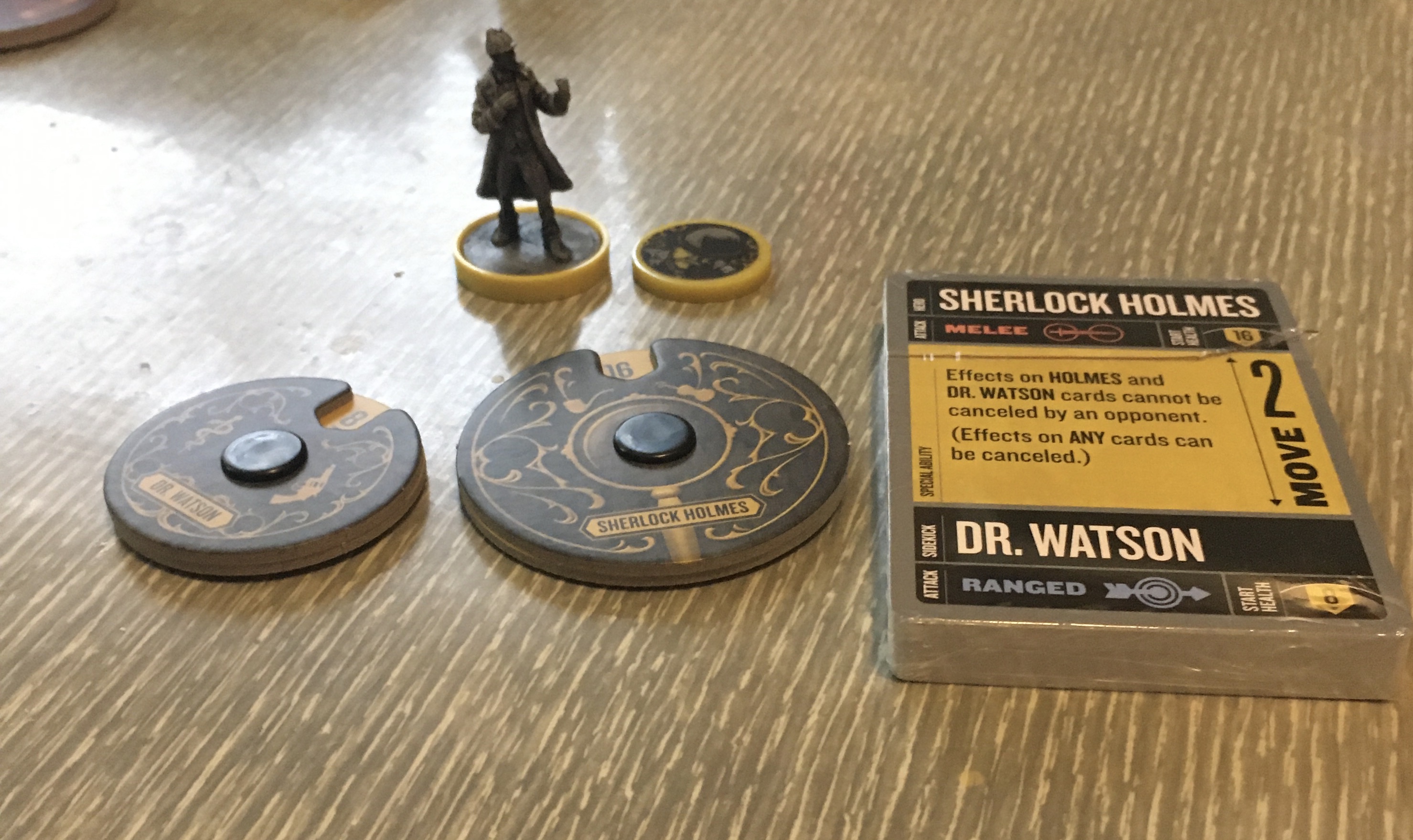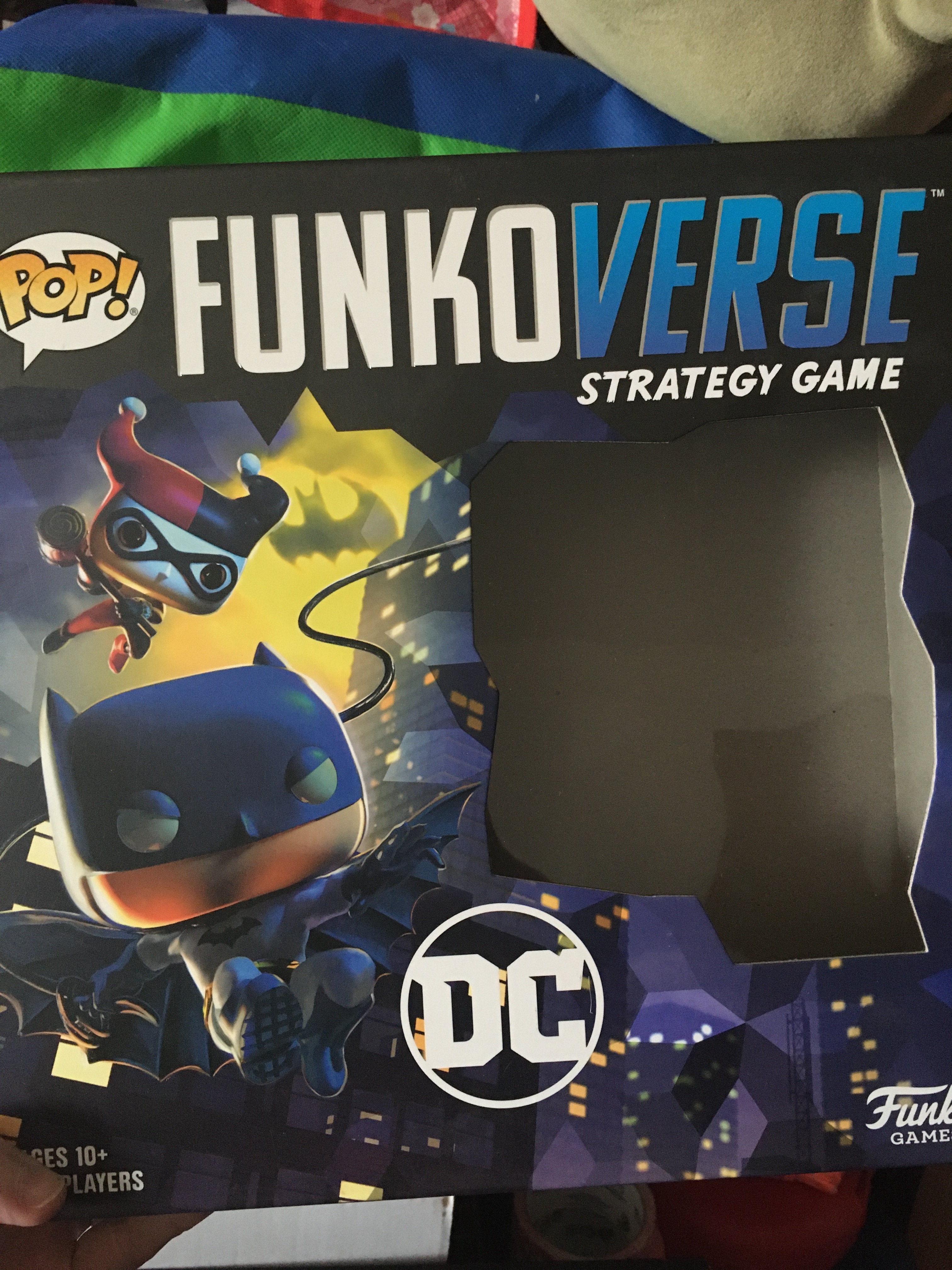
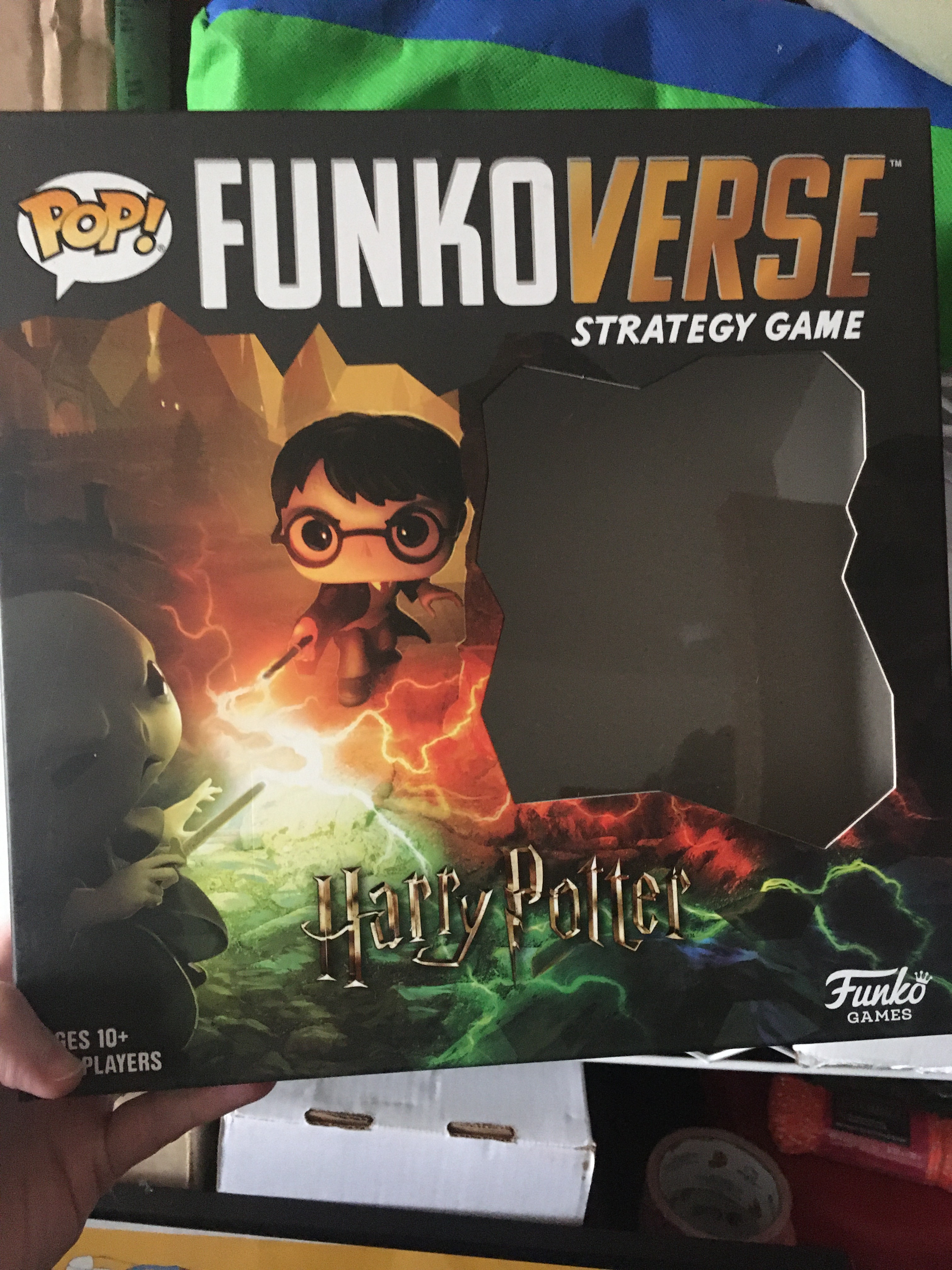
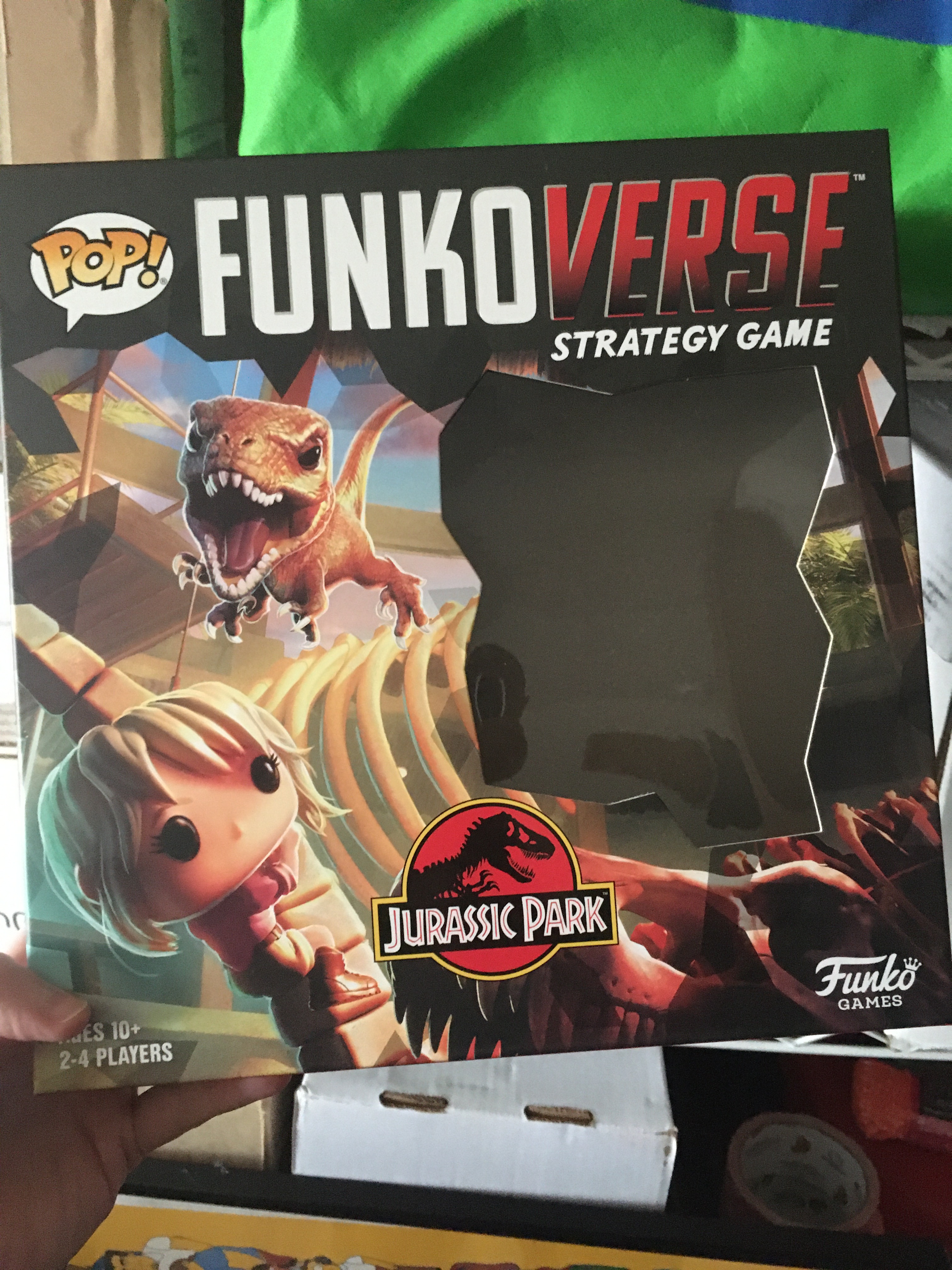
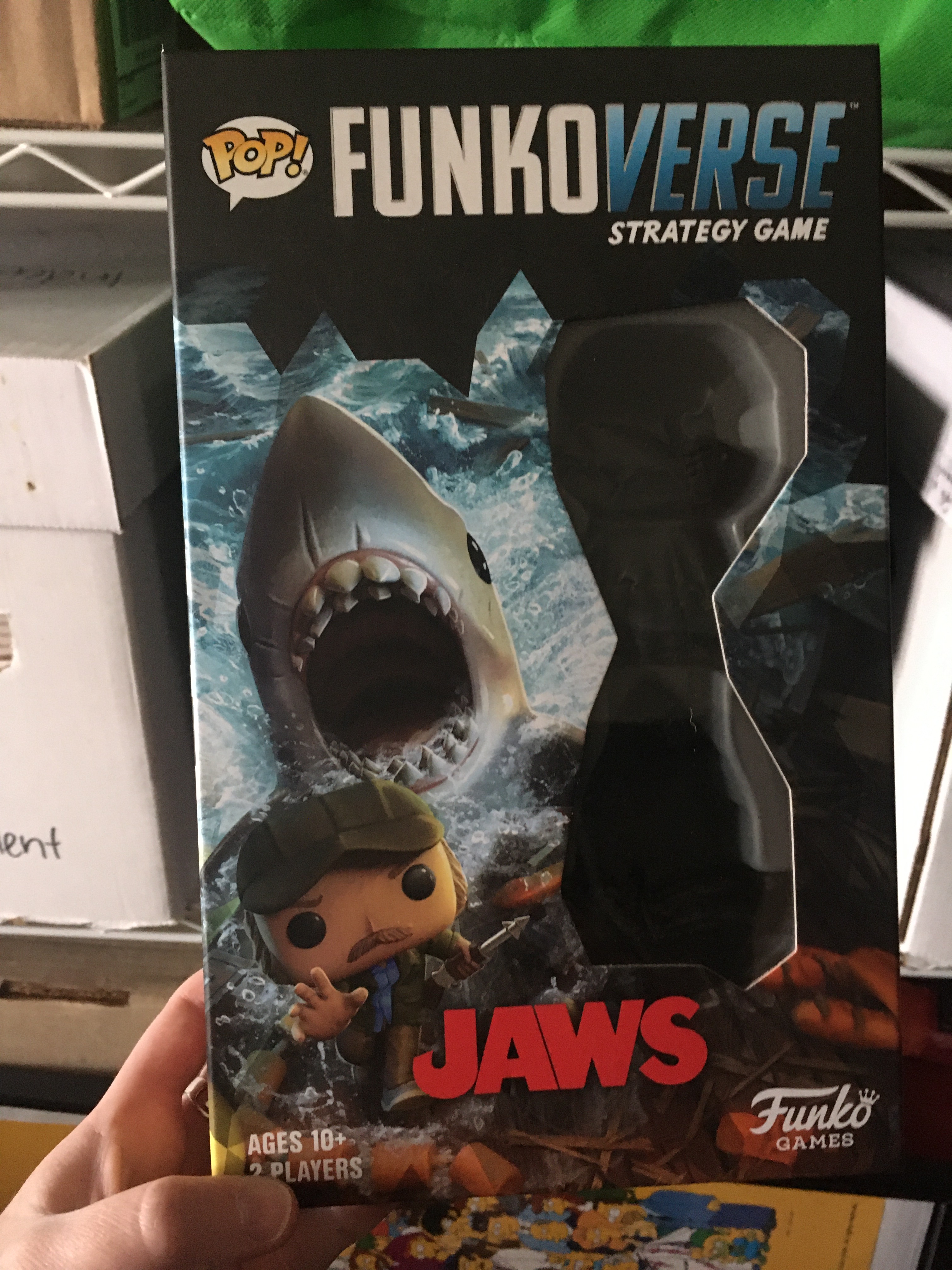
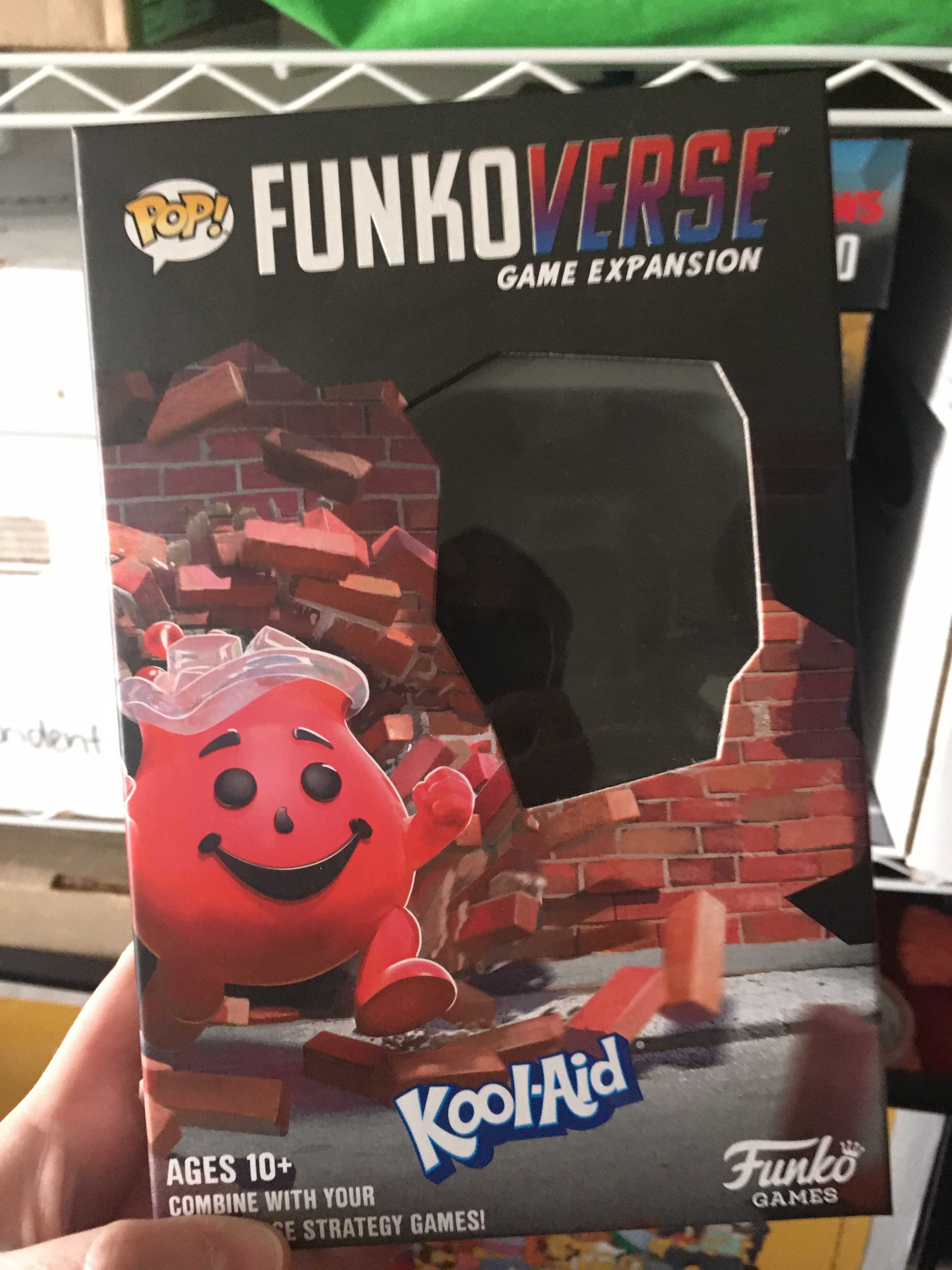
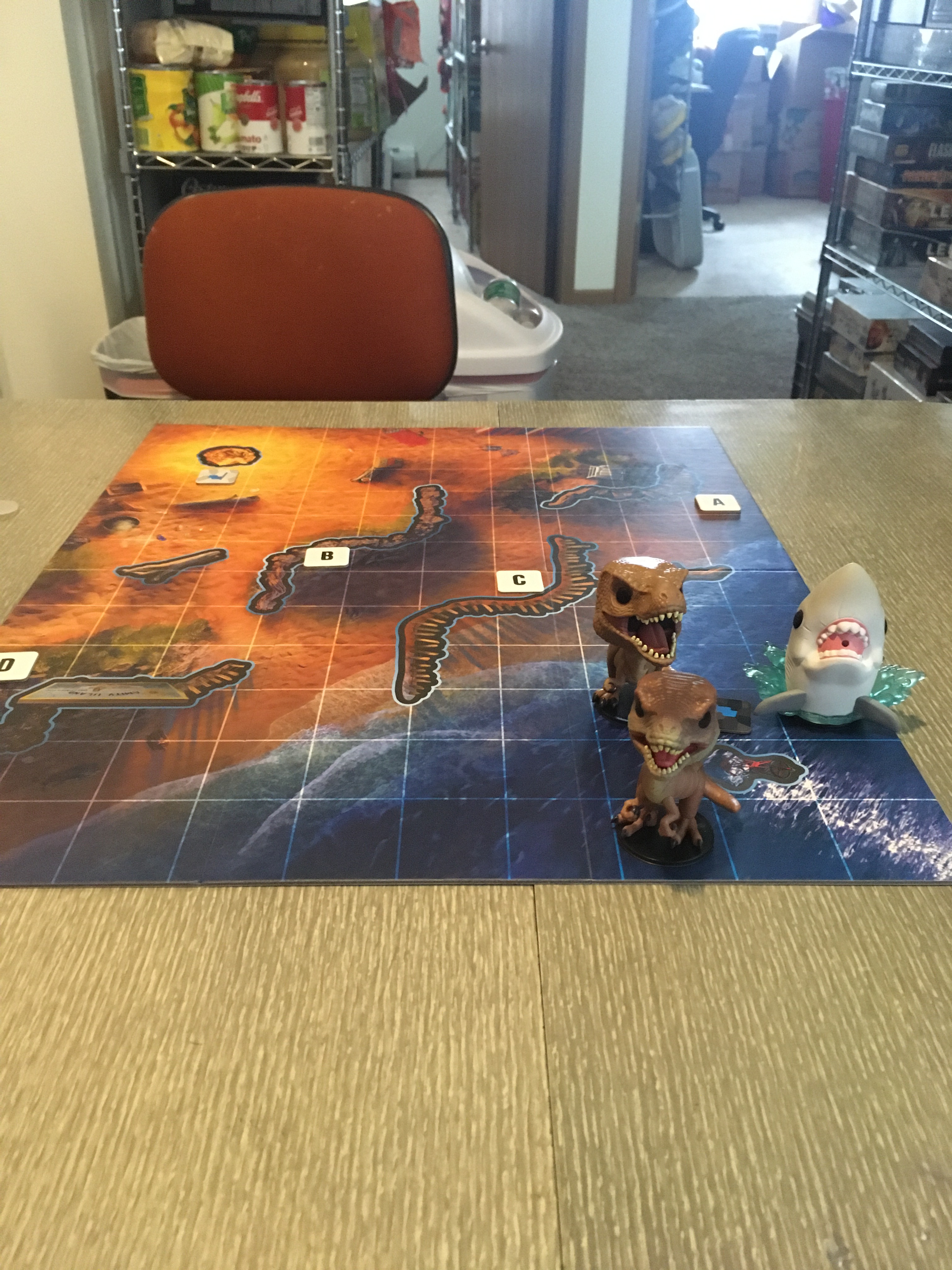
Funkoverse Strategy Game (Funko Games, 2019)

Basic details: 2-4 players; 20-60 minutes; competitive

Dates played: November 21 and 22, 2020

Expansions played: Harry Potter 100; Harry Potter 101; Jaws 100; Jurassic Park 100; Jurassic Park 101; DC Batman 100; Kool-Aid Man 100

Gist of the game: In a 2-player game, players choose up to 3 characters to play as a team against one another. Players place choose one of the two possible scenarios for their chosen map and then set up the map according to the scenario sheet, which will also specify the starting areas for each player. Players compete to win points, and the first player to cross the required points threshold (6 points if playing with 2 characters, 10 points if playing with 3) wins.

To play, each player chooses their characters and a single item (optional). Players receive the character card and any relevant status cards or tokens for their characters. Players take 2 ability tokens as specified on their character card. The map is set up as specified on the scenario card and player place their characters within their respective staring areas. Dice and point tokens are placed where both players can access them.

The game is played across rounds. Once every character has taken a turn, the round ends. To take a turn, players choose a character who has not yet taken a turn that round and take up to 2 actions with the character. The same action cannot be taken twice (we did not play according to this rule because we forgot about it. If anything it made the game more lively, so we may just house rule that option in the future). Characters have a set of basic actions: move up to 2 squares in any direction, including diagonally; challenge an adjacent rival; stand up an adjacent ally that has been knocked down; and interact with points tokens on the map. There are also a few special actions: use a character’s ability by spending an ability token; or use an item. If a character has been knocked down, the only thing they can do is use 2 actions to stand back up. Once the character’s turn is over, the player places an exhaustion token on the character card, and that character cannot take another turn in the current round. Play then passes to the next player, who repeats the process.

When all characters have been exhausted, the round ends. Players shift everything on their cooldown track down one number. Things that shift off the track (to below 1) return to play: characters return to their starting area, ability tokens are replenished, and item cards are returned to the character with the item. Exhausted tokens are removed from character cards, and the first player token passes to the next player. Players compare their scores at the end of the round. If the scores are tied, play continues until one player has more points at the end of the round. When that happens, that player wins.

To move a character, it can move to an adjacent or diagonal space, but not through rivals or obstructions.

Challenges allow characters to knock each other down and knock each other out. Every character can challenge an adjacent rival. When issuing a challenge, the player rolls 2 dice. When using an ability to issue a challenge, the player rolls the number of dice specified on their character card. The other player rolls a number of dice equal to their defense score. Th dice have faces for fighting an defense. If the challenging player has more successes, they win the challenge and the rival is knocked down, signified by literally placing the character’s Funko on its back. If a knocked down character is challenged and loses, the character is knocked out, removed from the map, and placed on the 1 space on the player’s cooldown track.

To use an ability, a character spends the appropriate ability token and places it on the cooldown track on the value specified on the character card.

Items can serve as abilities or traits, and some items have a challenge action associated with them.

There are lots of specific rules concerning line of sight and obstructions, but basically a character has to be able to see the rival to challenge it; characters can move through allies but not rivals to their final destination; and cannot move through obstructions, but rather has to travel around them.

Color commentary: This game is designed with near perfect modularity, such that any characters can be played in combination and on any map. I assume items are also perfectly portable, but we have not tried playing with items yet. There are only 4 scenarios total, repeated across the various map boards, but the luck component to challenges and the sheer number of possibilities means that there’s a lot of potential for replayability. I do think it’s a little disappointing that there are only 4 scenarios that just get repeated, but it seems like it might also be possible to create additional scenarios if you wanted.

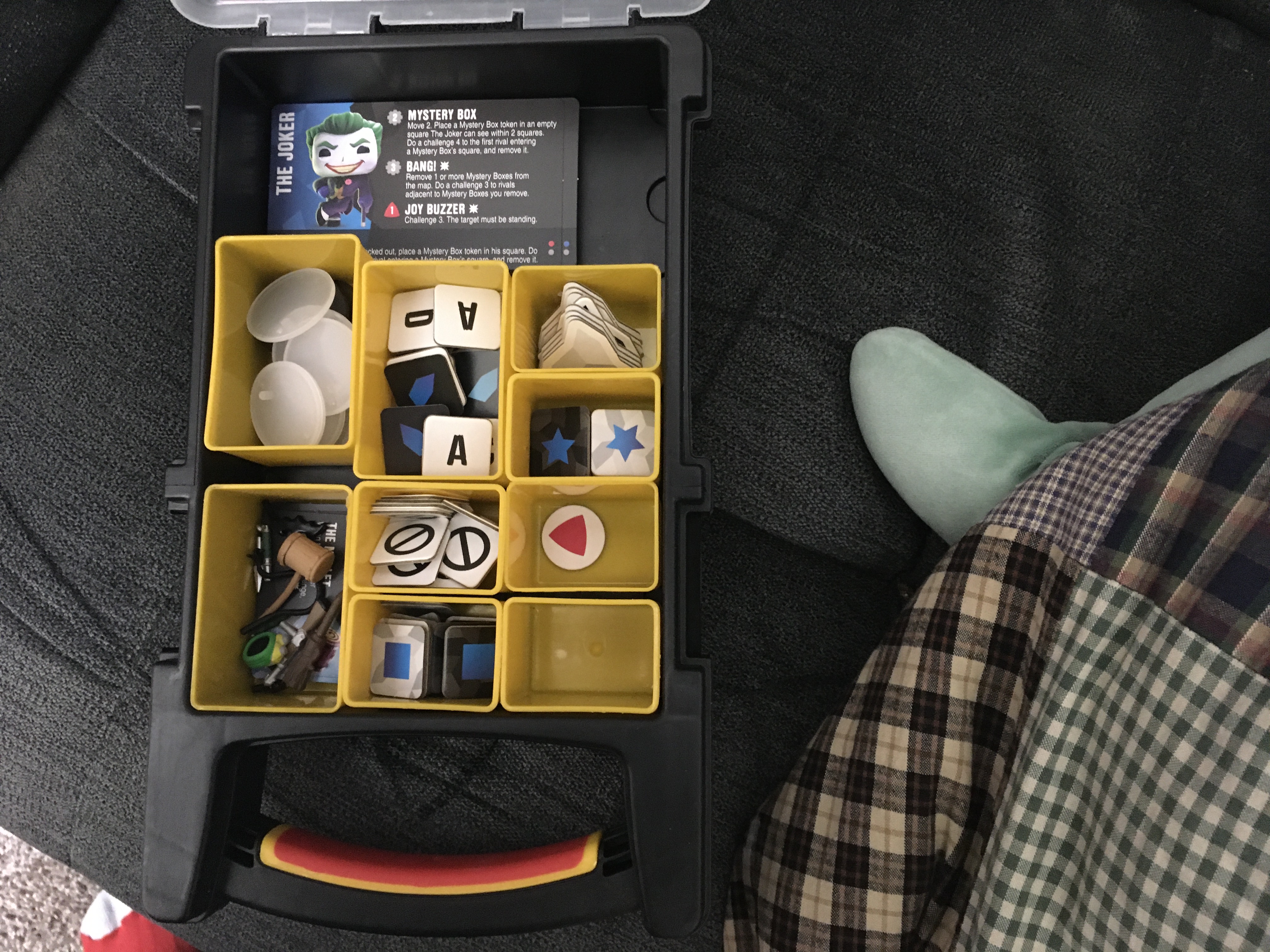
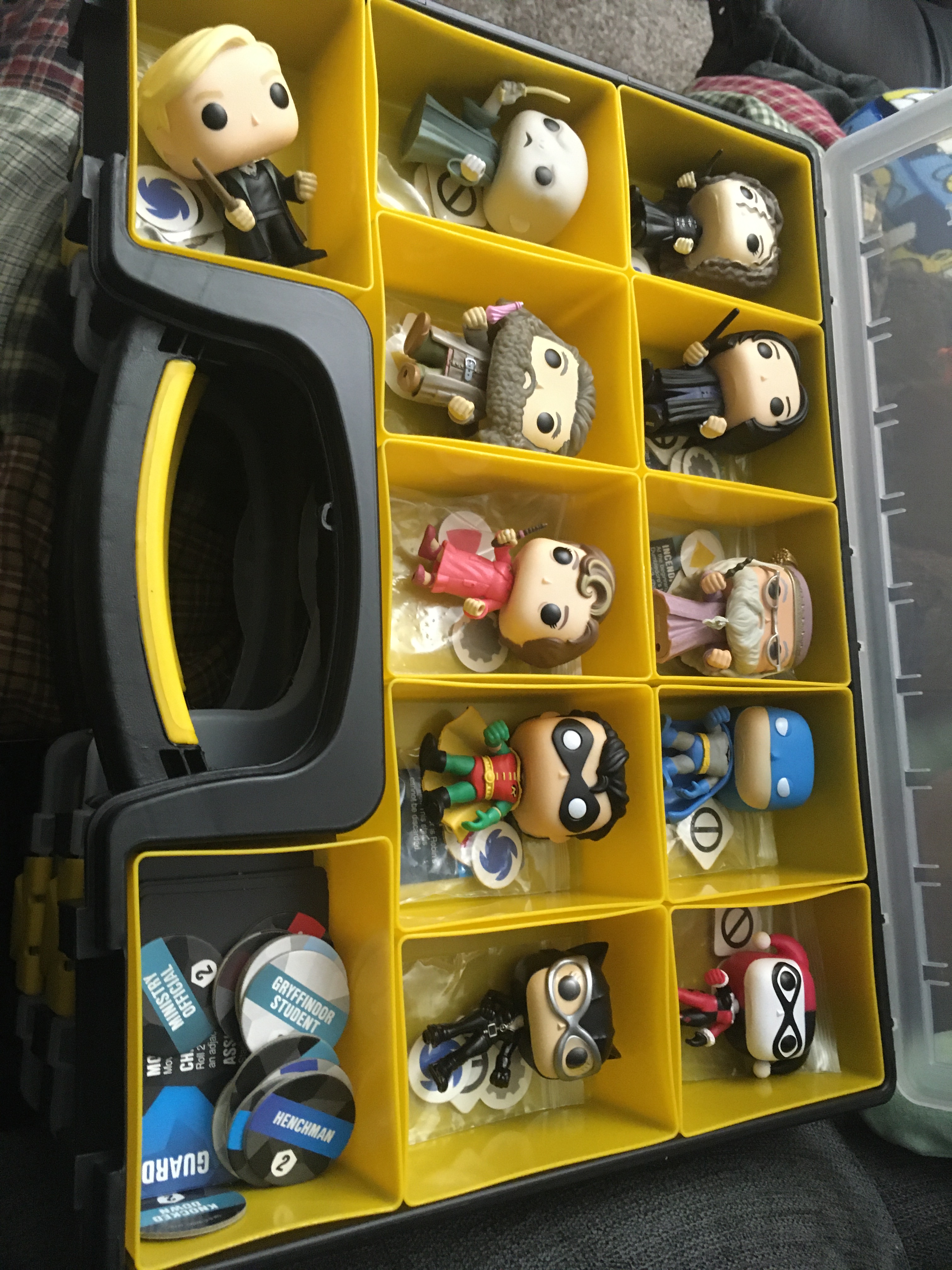
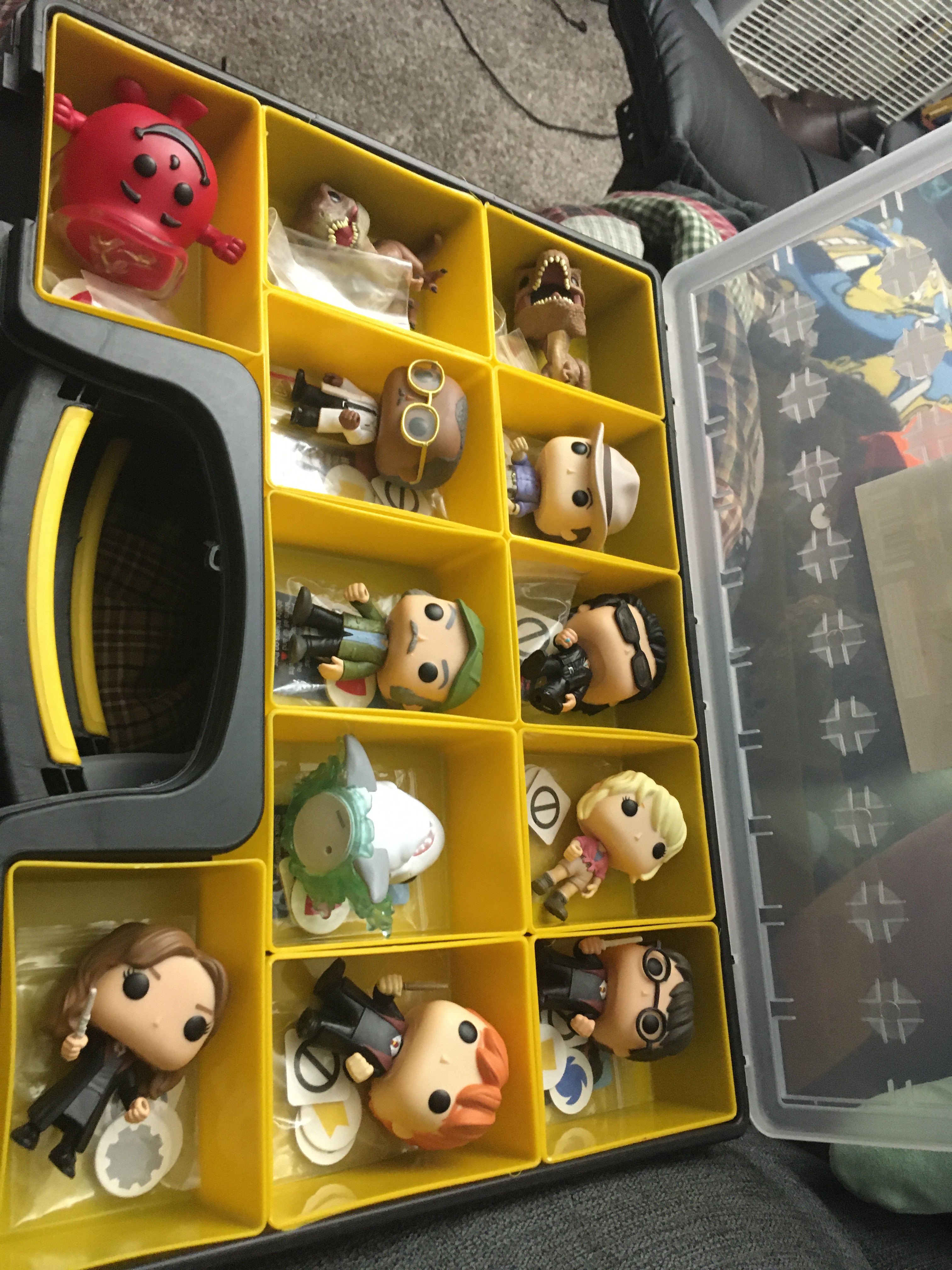
In essence, this is a tactical combat game with delightful miniatures. Perhaps as importantly, everything can be organized into nifty containers from Harbor Freight (ok… maps are in a large post office mailing box while I figure out a better solution for them). The large number of possible characters and all the tokens to sift through made the first set of games kind of a hassle to set up. We spent a chunk of yesterday afternoon organizing everything, and setup was much easier.

The tactical combat part is important to note, because there were multiple pages spent on line of sight, and combat is resolved strictly through dice. It reminded me a bit of Memoir ’44 in that respect. I’ve seen chatter on board game discussion forums declaring that Unmatched and Funkoverse are in no way similar to each other, but I would argue they are. Combat is resolved differently, sure, but both games have: a) perfect modularity; b) a basic goal (points in Funkoverse, which can be gained in part through knocking characters out; defeating the hero in Unmatched); c) maps; d) nifty figures; e) high player interaction since victory can only really be gained by doing things to the other player’s characters. I suppose you could win a Funkoverse game by just acquiring points tokens over time, but that seems an unrealistic scenario, and unlikely that the other player would be following the same strategy. So, again, the combat mechanisms are different (cards for Unmatched, dice for Funkoverse), but the spirit of the games feels similar to me, which isn’t a bad thing.

Furthermore, I did thoroughly enjoy going shopping at Harbor Freight for our containers and then packing everything into them, as evidenced by the pictures above which showcase my handiwork. I am soliciting suggestions for map/cooldown track/booklet storage, so let me know if you have any ideas. The big challenge with the maps is that they come in two different sizes. Most of them are fairly narrow, but two of the base boxes came with wider maps, which eliminates a number of possible solutions. The search will continue.

On our first day of playing, we stuck with just the first couple Harry Potter sets. I played Voldemort, Draco Malfoy, and Belatrix LeStrange. M played Harry Potter, Ron Weasley, and Hermione Granger on the Forbidden Forest map. We played both possible scenarios for that map, “Leaders” and “Control.” “Control” had a definite 1st player advantage because once you move into a new control area, you can place a control token for free, but if you move into a location that already has a token, you have to use an action to flip it. So the first player can control an area on their very first turn, earning both a point at the end of the round for controlling any areas as well as a point for controlling the most areas, whereas the absolute earliest the second player would be able to flip a token would be in the 2nd round. The “Leaders” scenario sees players earn points for knocking each other’s characters out, thus favoring an aggressive strategy. Upon a debriefing of why I lost so miserably yesterday, M informed me that I seem to lack the killer spirit, and have basically lost every game scenario we’ve ever played that favors aggression as the dominant strategy. I’ll let him explain more below.

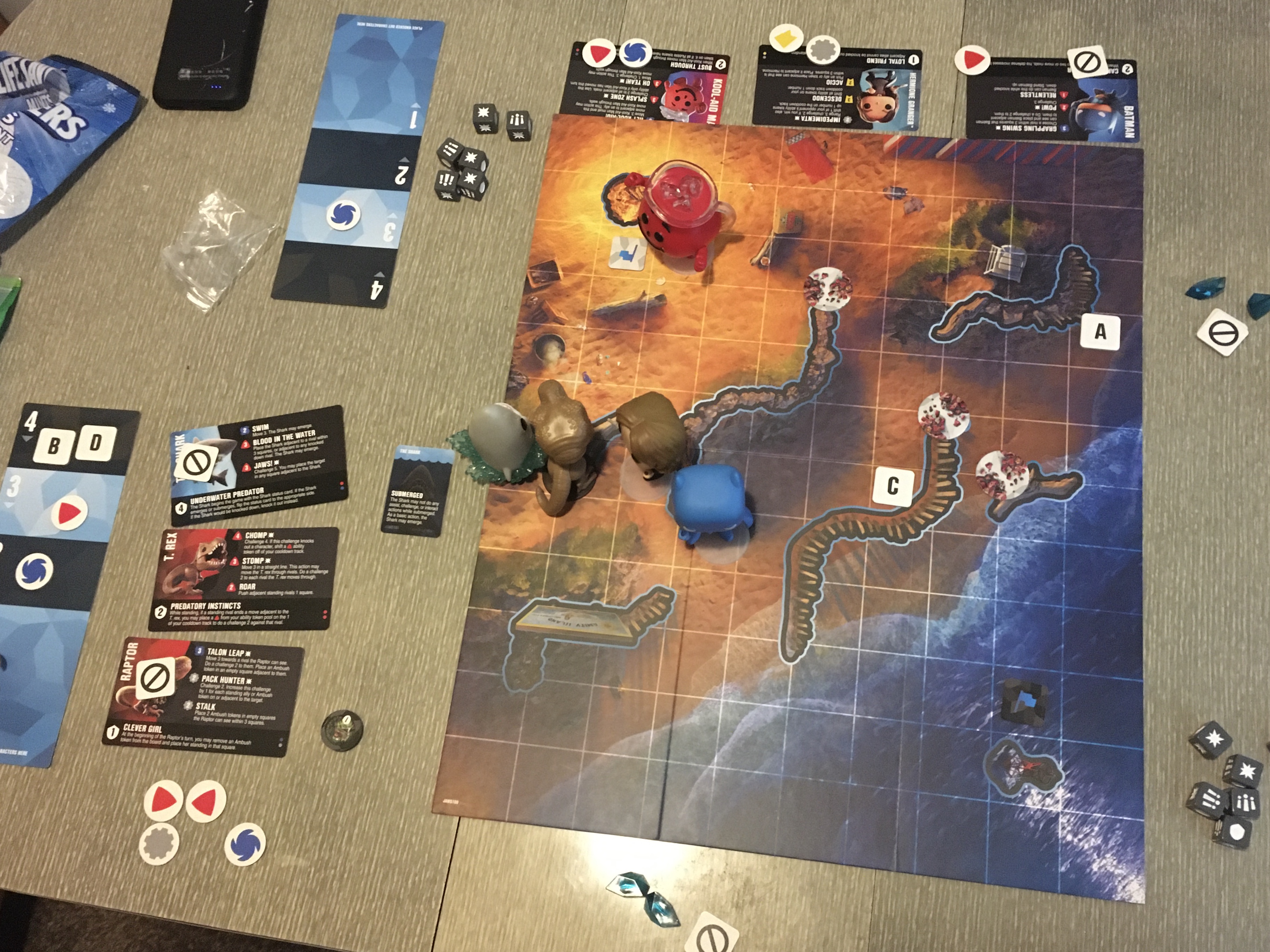
For our third game, we embraced the modularity. I played the Shark from Jaws and the T-Rex and Raptor from Jurassic Park. M played Batman, Hermione, and the Kool-Aid Man. We played on the South Beach map from the Jaws pack. For this map, we played the “Flags” scenario, which I won, despite M’s hard turn toward attrition less than halfway through the game, where he no longer tried to make it to my flag, and instead spent all his energy thwarting my attempts to be adjacent to his flag at the end of the round (moving your character from by the flag back to your starting area earned the most points out of the points-earning options).

Thoughts from M: Look. I’m going to say it’s a fun game, and you’re going to say I say that all the time, and I’m going say that you’re right, but also that if a game isn’t fun, what’s the point? Like most combat games, it rewards aggression, which is especially true when you have two players (I’ll comment more on Petra’s soft heart in a moment). The “Control” scenario we played rewarded rent-seeking, which I exploited whole-heartedly, but wasn’t as much fun as the more combat-based interactions we had in the “Leaders” scenario, where you basically the only way to earn points (aside from points tokens) was by knocking out each other’s characters.

As we were playing with the Harry Potter characters on our first couple run-throughs, I got to thinking. Why was JK Rowling so determined to relate the events of the books to muggle years? I mean, a huge deal is made about the final Battle for Hogwarts being in 1998. That naturally raises the question of what impact the rise of Tony Blair had on the wizarding world. Did Cool Britannia inspire Harry and friends? And then later did Blair did try to recruit them Wizards to fight in the War on Terror? I bet that would have really impressed Bush. And then were Death Eaters sent to Gitmo? So many unanswered questions. Someone should write a book about it. (Actually I did some research into this topic and found out that Voldemort was behind the death of Princess Diana, and now the entire Harry Potter universe must be viewed in a new light with me wondering if Dobby was tragically manipulated into fighting on the side of evil. Was he really a free elf? Was he?)

Now, in terms of Petra’s infinitely exploitable weakness… I mean, kind heartedness, I’ve noticed a trend in games like BarBEARian Battlegrounds and Unmatched, that when the situation calls for aggression as the only possible way to avoid losing by attrition, she will quite doggedly embrace getting ground down rather than engaging in aggression herself. And for that, I love her, both because it lets me win games and because she’s probably a better person than me.

M’s rating: 6/10
Petra’s rating: 6/10
Azul, Reef, Sagrada, Tiny Towns Head-to-Head-to-Head-to-Head

All four of these games are premised on constructing some kind of thing on a grid.

Reef and Tiny Towns construct on a 4×4 grid while Azul and Sagrada construct on a 5×5 grid.

Tiny Towns and Reef start with completely open grids and allow for pretty much completely open placement, though those decisions then create constraints on future opportunities.

Azul and Sagrada both begin with templates of sorts (though Azul has a more open possibility), which creates external constraints, both because of their patterns and because of external constraints like placement rules (can only place orthogonally adjacent, etc.)

I set out on this experiment to see if we “needed” to keep all 4, or whether they overlapped to such an extent that perhaps one or more might be dispatched from our collection. But they all play sufficiently differently that I feel like they are very different games that I might want to play under different conditions. Azul is more relaxing than Reef or Tiny Towns, which in some ways feel more stressful because of the internal constraints that you impose on yourself. I love the pattern-matching in Sagrada and Azul, and the essentially puzzle creation in Tiny Towns and the vertical component of Reef.

In short, if you’re into game collecting with the purported intention of playing, much like the pandemic has made us (ok, I’m making M complicit in this — this is essentially my rodeo that he willingly shows up to play in (M here: this is absolutely the case as I, of course, have zero books, comic books, or records that I have not read or listed to)), I think having all 4 in a collection is well-justified.

Here are our overall ratings of the 4:
Petra: Sagrada > Azul = Reef > Tiny Towns
M: Reef > Tiny Towns > Azul > Sagrada

Reef (Next Move, 2018)

Date played: October 31, 2020

Basic details: 2-4 players; 30-45 minutes; competitive

Gist of the game: Players design a coral reef using 4 colors of coral to accrue points based on their coral configurations, identified on cards. The player with the most points at the end of the game wins.

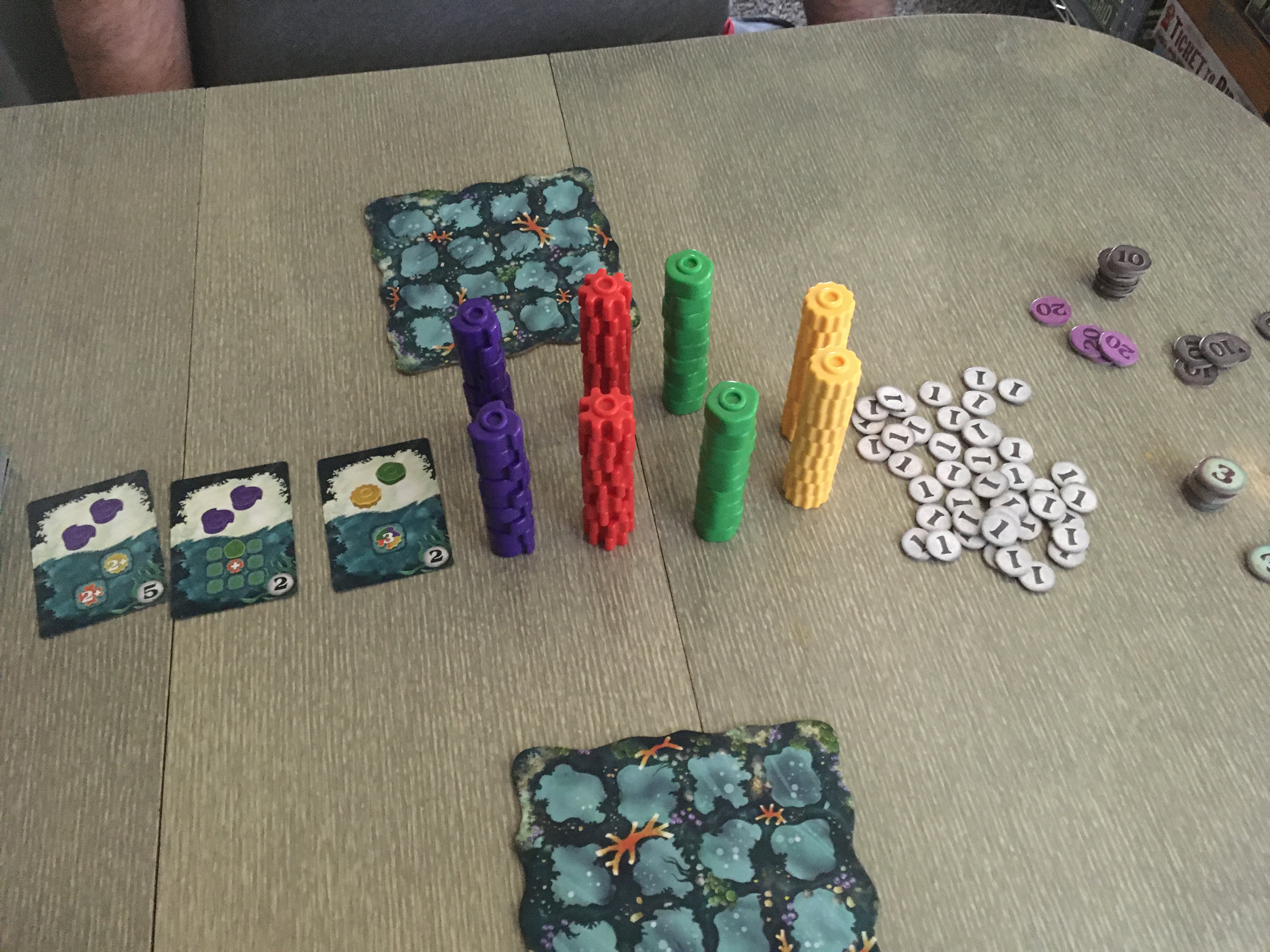
Players begin the game with 3 point tokens, a 4×4 player board, 2 cards, and 1 coral of each color.

3 cards are placed face up for the coral display and the remainder of the deck is placed face-up next to the display.

Reef is played over a series of rounds, with one turn per player per round. On a turn, players must take one of two actions. They can take a card from the display or deck into their hand. A player can have no more than 4 cards in their hand. If a player chooses to take a card from the deck instead of the display, they must place a point token on the lowest-value card in the display.

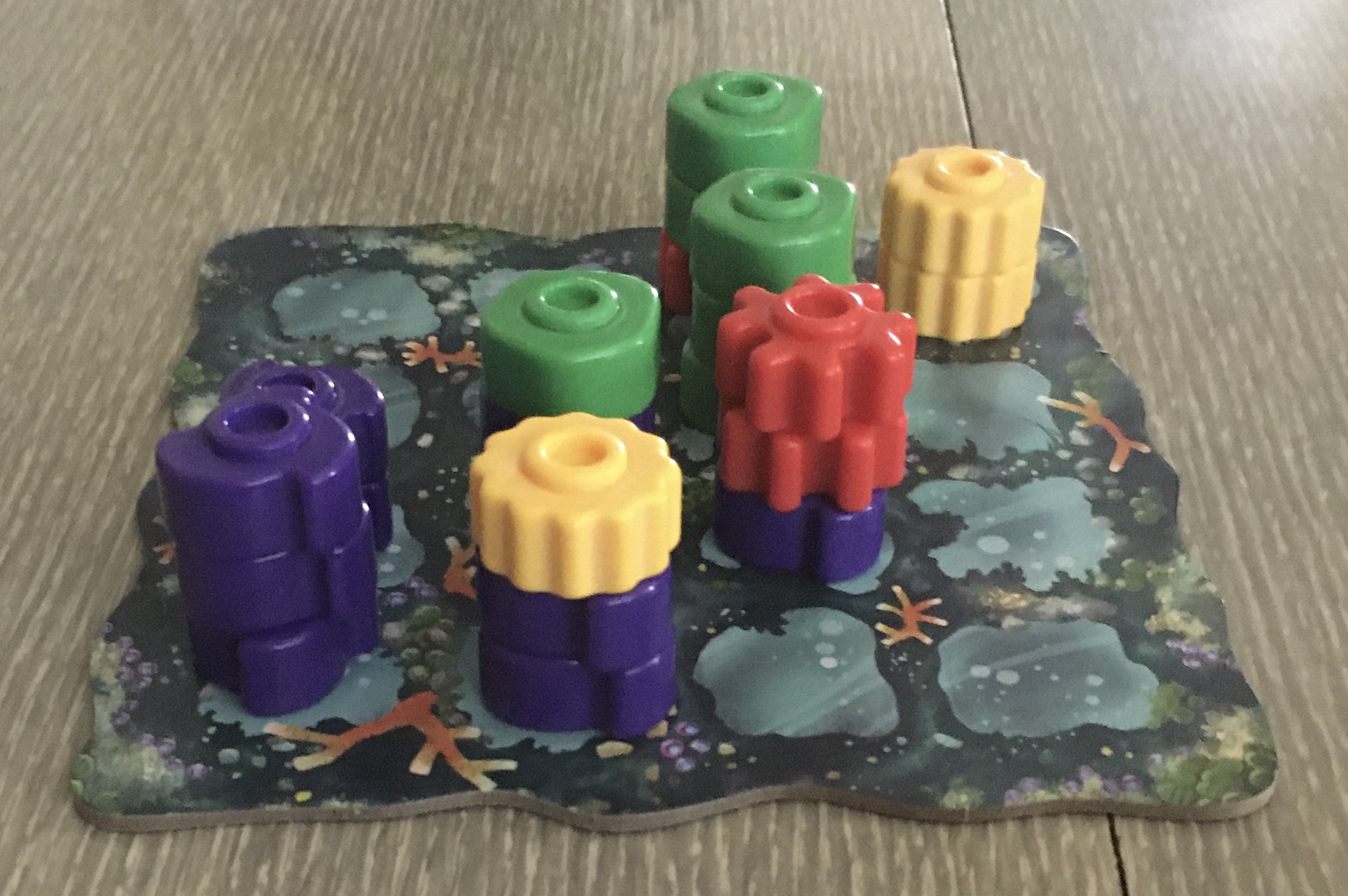
When playing a card, a player takes the two pieces of coral indicated on the top of the card, places them on their board, and then may score their board according to the configuration of coral on the bottom of the card. Players do not have to be able to score in order to play the card, but they must place the designated coral anywhere on their board. Coral may be stacked up to 4 high, but it is only the top color coral that matters. Some cards require reef to be some exact height, or a minimum height in order to score.

The end of the game is triggered when any one color of coral runs out or the card deck runs out. Once one of those conditions is met, the rest of the round is finished before scoring takes place. Players may score configurations of cards remaining in their hands once, even if that pattern appears more than once in their reef. The player with the highest score wins.

Color commentary: The large plastic reef pieces give the game a fun tactile experience. As should come as no surprise to anyone who reads the blog as regularly as we post, we played the first game incorrectly because I forgot the specific language of one of the rules. In the first game, we took and placed the coral pieces when we drew the card, rather than when we played the card. As I in fact noted at the time we were doing this, “It’s hard to balance taking coral with playing cards. I wish you could do both on the same turn, or at least have the option of doing both, like maybe taking two actions on a turn.” On the other hand, playing it in that particular incorrect game introduces greater strategy, especially as the end of the game nears, in order to get the coral you need now to play more valuable cards later. Playing correctly, there’s still some tension, but a lot less. For a slightly deeper game, our inadvertent house rule could be used.

It’s interesting to balance shorter-term scoring opportunities with playing a longer game for more valuable scoring opportunities later because the coral you have to take may or may not be in any way related to the possible points available from a card. For instance, I had a card that would grant 2 points for orthogonally adjacent greens and yellows both of which were at least 2 high, as well as a card for any 2-high stacks orthogonally adjacent to one another. The pairs of tiles on each card were worth the same points, but playing one first might facilitate additional points that would not be earned by playing the other card first on the basis of which coral each card provided.

Micah won the first game in a 62-63 squeaker. I won the second game 65-60, and in the third game, there was a glut of cards giving purple coral, so the game was much shorter than the other two and I won in a blowout of 52-42. However, M also revealed that he had a path to victory that he opted not to take in order to prolong the enjoyment of playing the game. I feel like I should be offended, but let’s be honest, I’ll take the win.

Thoughts from M: The rules (or at least the way Petra described them to me) make the game seem more complicated than it feels when you’re actually playing. There are lots of things to keep track of, but this game is a ton of fun. It involves spatial recognition, color combinations, and cards conveying two separate pieces of information, all of which I am terrible at, but this game was the most enjoyable of the set of 4 we matched up (a comparison post is in the works).

Petra’s rating: 7/10
M’s rating: 8/10

Rating scale:
10 – super fun game that I can see myself playing frequently well into my retirement years (M’s 10 benchmarks: Lost Cities, King of Tokyo; Petra’s 10 benchmarks: Carcassonne as a bundle of all its expansions and forms, Dinomals, Kingdomino)
8-9 – really fun game that I’m happy to play again and again
6-7 – fun game that might get old at some point
4-5 – fun game to play sparingly
2-3 – game I don’t especially enjoy but will play if my partner really liked it
– game I never want to play again (joint 1 benchmark: SeaFall, which was so terrible we never made it to actual gameplay)

Tiny Towns (AEG, 2019)

Date played: October 25, 2020

Basic details: 1-6 players; 45 minutes; competitive

Gist of the game: You are the mayor of a small forest settlement trying to develop your town through additional building projects, but these buildings require various resources, which you must be strategic about gathering and utilizing.

Players receive a 4×4 grid on which they will build their town. Each building players build will earn victory points, and the player with the most victory points at the end of the game wins.

To set up the game, the cottage card is placed face-up in the center of the table. The remaining buildings are sorted by symbol into piles, shuffled, and once card from each pile is placed face-up alongside the cottage to form the set of possible buildings for the game. The remaining building cards are placed back in the box. The wooden resource cubes (wood, wheat, brick, glass, stone) and building meeples are placed in a common supply area. Each player receives two monument cards, of which they select one and place the other in the box. Each player then receives a monument meeple.

Monuments are special buildings that are unique to each player. They can only be built once, but can be constructed in any round, just like regular buildings. When the monument is constructed, its card is read aloud and its immediate effects are resolved. The monument is scored at the end of the game, just like regular buildings, though the monument have have effects or abilities that will carry through the remainder of the game.

The game is played over a series of rounds. The first player names a resource, and all players must take a cube of this resource and place it on an empty square in their town. After being placed, resources cannot be moved to another square in the town, and can only be removed from the town by constructing a building. Only one resource can be placed per square. After placing resources, players may (but do not have to) construct any buildings they can, matching their resource configurations to the resource placement requirements on the building card. This is done simultaneously, and players announce which building(s) they construct. Once all players have placed their resources and constructed any buildings, a new round begins with first player status passing to the next player.

In order to construct a building, a player’s resources must match the shape/color configuration presented on the building card (but the shape is valid along any 90 degree quadrant). The resources are removed from the board and the building meeple is placed in one of the squares that had previously been occupied by the required resources. A resource can only be applied toward the construction of one building, but players can wait however long they wish to construct the buildings, and may construct multiple buildings in a turn. Once built, buildings cannot be moved. Except for monuments, which are unique to each player, any player may build any building — buildings are common among the players and can be built any number of times by each player.

When a player’s town is filled with resources and they cannot or will not construct any additional buildings, their town is complete. They are out of the game and no longer take turns as the first player. The game ends when all players’ towns are complete. At this point, all remaining resource cubes are removed from the board (except any affiliated with a warehouse-type card) and players lose a point for each empty square in their town. Players earn points for each building according to that building’s guidance and the player with the most points wins. In order to score points, cottages must be “fed” by agriculture-related buildings in the town. Fed cottages are worth 3 points each; unfed cottages are worth 0 points.

Color commentary: This is a game heavy not only on spatial reasoning, but also ability to envision multiple possible arrangements of resources in order to maximize their options and useful buildings for any strategy they may be using.

Both M and I definitely over-built farms in the first game, as each farm can feed 4 cottages and neither of us had more than 4 cottages (but we did have 3 farms each, the other two of which served no real purpose because they don’t score points in and of themselves, they just allow cottages to be scored). We likely overbuilt because they were easy resource configurations to put together, but clearly we were a bit short on strategy in this go-around.

There’s a lot of strategy for where to put buildings when to keep as many options open as possible for future resource placement. There were several times when I realized too late that I had cut off possible configurations even though the total number of spaces was sufficient (but not the location of those spaces). In all 3 games we played, we both spent our first several turns constructing our monument because they tended to make future moves easier to deal with and opened up more possibilities for point accumulation. M’s monument in the second game was extremely beneficial, as he could place buildings in any open space, not just spaces that the resources had occupied. Largely as a result of this, he won that game in a 12-point blowout. Actually, his third monument was also extremely useful, as his 756,982 empty spaces at the end of the game scored 0 points, as opposed to -1 point each, which is what clenched that victory from him.

To do well in the game, it may be necessary to balance helping yourself and perhaps trying to cut off opportunities for your opponent (I think M was going for a simple strategy of maximizing his own points, but when the way he was carrying out that strategy became clear, it was in my interest to try to limit the extent to which he could continue to capitalize on that strategy). On the other hand, we also communicated during the games to try to help each other out (though obviously some of us, namely me, were much more helpful than others of us, primarily M).

The game does have a beat-your-score solo option as well as an expansion. Coupled with the fact that there are multiple buildings within each type and each individual building as a unique resource configuration, there’s a lot of replayability here across various formats.

Thoughts from M: (note from Petra here: M was struck speechless by his 3-game sweep of a spatial reasoning game, including one especially unbalanced game which he won by double digits.) This was a fun game that I believe could be a higher strategy game, but I’m not sure what the proper strategy would be. The meeples are wonderful.

Our ratings of the game:
M’s rating: 5/10
Petra’s rating: 7/10*
*losing repeatedly and by not especially narrow margins 3 games in a row probably does temper my enthusiasm somewhat

Rating scale:
10 – super fun game that I can see myself playing frequently well into my retirement years (M’s 10 benchmarks: Lost Cities, King of Tokyo; Petra’s 10 benchmarks: Carcassonne as a bundle of all its expansions and forms, Dinomals, Kingdomino)
8-9 – really fun game that I’m happy to play again and again
6-7 – fun game that might get old at some point
4-5 – fun game to play sparingly
2-3 – game I don’t especially enjoy but will play if my partner really liked it
1 – game I never want to play again (joint 1 benchmark: SeaFall, which was so terrible we never made it to actual gameplay)

Food Chain Island (Button Shy Games, 2020)

Basic details: 1 player; 20 minutes; no automata

Date played: October 21, 2020

Gist of the game: You are trying to facilitate animals’ meals on a lonely island.

Sixteen animal cards (value 0-15) are shuffled and randomly dealt into a 4×4 grid. Two sea creature cards, whale and shark, are placed off to the side for use during the game.

On each turn, choose one animal on the grid to be the predator and move it one orthogonally adjacent space onto an appropriate prey. The predator can only eat prey values 1-3 below that of the predator. When the predator eats the prey, those cards form a stack, which is treated as a single animal with the identity of the top card. When the predator has eaten its prey, the predator’s special ability is activated.

Some special abilities require animals to move. Animals must move to open spaces, but these open spaces can be outside the original grid area. If an animal moves multiple spaces, it can: move over other animals but must end on an open space; and move in multiple directions, but it cannot end where it began.

At any time during a turn, one or both of the sea creatures’ abilities can be used. Sea creatures are discarded once their ability has been used.

The game ends when you are unable to make a move. If there are three or fewer animals left on the island, you win. Sea animals do not count toward this total..

The game can be made more challenging by trying a different starting grid configuration or by omitting one or both of the sea animals.

Color commentary: This was my first experience with a wallet game, but I’ve heard a lot of good things about Button Shy, and I had a discount from backing a Kickstarter, so I decided to splurge a bit and stock up on interesting looking games in their library. This game takes up a bit of table space because of creating the grid (but by no mean an onerous amount), but you can’t get much smaller packaging than a container about the size of a business card holder. Because of the packing space, this seems super nice for travelling, should such a thing ever be allowed to occur again. I can definitely see myself taking a game like this to Myanmar to play in my hotel room or in the airport waiting a billion hours on layover. Even better if it’s a Tokyo airport and I can eat Tokyo Banana Company snacks while playing, but I digress…

In the first game, I had 10 cards left, but then remembered the sea animals. I used the whale to move one animal to any other space, and the shark to move an animal one space to eat an animal of any lower value, ending the the game with 6 cards. I ended the second game with 5 cards left, and the third game with 4 cards. Bolstered by this progress, I tried again, and ended with two animals left. Victory! With two remaining animals, I ended with the status of “Accidental Matchmaker.”

I know a lot of people prefer interacting with automata for solo games rather than “beat your score” type dynamics, but I’m unconvinced I’ve ever implemented an automata correctly, and I enjoy the simplicity of beat your score mechanisms.

Overall, this is a breezy, quick game that nonetheless makes you think. It clearly took a few attempts to do well, but on each play I feel like I was making more considered and careful decisions about which predators to move. It’s hard once you start having gaps between the cards, because then you might really need to be able to move an animal multiple spaces to make it adjacent to an appropriate other card, but many special abilities only really allow for movement of one space. Special abilities can also work against you by forcing you to move animals you can’t really afford to move, usually further away from all the other animals, or requiring your next turn to occur in such a way that making an appropriate move is actually harder.

Thoughts I think M have if he had played: There’s definite strategy here in choosing which predator to make the opening move with, and what choices you make following on, but there’s also definitely an element of luck as to whether the cards end up initially placed in such a way to make victory technically possible. The rules are super easy to pick up on, and the game does have a fair amount of strategy for such a simple setup and short gameplay. I would also be remiss if I did not note that the artwork was cartoonish and fun. But, most importantly, why do all the cute animals have to eat each other?

Azul (Next Move, 2018)

Basic details: 2-4 players; 30-45 minutes; competitive

Date played: October 18, 2020

Gist of the game: You are a newly-hired tile-laying artist charged with recreating the style of Moorish wall decorations for the Portuguese king.

To create your masterpiece, you are given a game board with a pattern. A number of factory displays (varies based on the number of players: 5 for 2 players) with 4 randomly selected tiles each are placed for all the artists to reach (you might note that our factory displays above have 5 tiles each. Indeed they do, because I read the rules to prepare to teach the game like a week ago and forgot that they’re only supposed to have 4 tiles each. On the other hand, the only player this probably actually hurt was me, when I had to take two consecutive rounds with -14 points because of having to take tiles I couldn’t use). The object of the game is to earn the most points for your display by the time any player finishes a horizontal row of 5 tiles.

Play proceeds over a series of rounds, each of which has 3 phases: factory offer, wall tiling, and preparing for the next round.

During the factory offer phase, each player either takes all the tiles of the same color from one of the factory displays and places the remaining tiles in the center of the table or takes all the tiles of the same color from the center of the table. The first player to take tiles from the center of the table in a round puts the first player marker in the leftmost space of the “floor line” on their board, which will cost them points at the end of the round. Players must then add their tiles to the staging area on their board. The staging area has five rows with ascending spaces — the first row has one space, the fifth row has 5 spaces. Tiles are placed in the staging area from right to left, and all tiles placed in a row must be of the same color (but a row does not have to be filled in a single turn). Once all of the spaces of a row are filled, a tile from that row will be moved to the accompanying space in that row on the wall portion of the player board. If a player has a number of tiles in excess of what they need to fill a row of the staging area, they place these extra tiles in the floor line of the board.

In later rounds, players may not place tiles in a staging area row if the corresponding wall row already contains that color. The factory offer phase ends when all tiles have been removed from the factory displays and the center of the table.

In the wall tiling phase, players move tiles from their completed staging area rows to the wall area. The extra tiles from the staging area rows are then discarded. Players immediately earn points for the tiles they place in their walls. If there are no tiles orthogonal to the tile just placed, the tile earns one point. If there are tiles orthogonal to the tile that was just placed, the players earn one point for each vertically linked tile and one point for each horizontally linked tile (including the tile that was just placed). At the end of the wall tiling phase, players lose points based on the number of tiles in their floor row. These tiles are then discarded, and the first player marker is held out for continued use.

At the end of the wall tiling phase, if no player has completed a horizontal row, players prepare for the next round by refilling the factory displays (using tiles previously discarded if necessary). At the end of the game, when a player completes a horizontal row in the wall, players gain 2 points for each completed horizontal row in their wall, 7 points for each completed vertical column, and 10 points for each color that has all 5 tiles placed in the wall.

There is also a variant board on the reverse side of the player board in which players can create their own wall design, placing tiles from their completed staging rows anywhere on the board so long as no color appears more than once in a vertical column.

Color commentary: Before I write anything else, M insists that I disclose that we split this matchup, winning one game a piece. My victory in the second game was especially sweet for having lost 28 points across two rounds because of tiles in the floor row.

So…in addition to putting too many tiles on the factory displays, we also scored incorrectly. Oops. Perhaps I will review the rules a bit more carefully next time when there’s been a long gap between first becoming familiar with the rules and trying to teach the game. Heh.

I really enjoyed this game, and found it pretty calming. There were times when M took tiles I had my eyes on, but it felt silly to get worked up about something so soothing as pattern matching and tile counting. Across both games I tried to maximize my own points without worrying too much about trying to sabotage M, so I doubt I did anything particularly thwarting that would have thrown off his whole game. I’d be interested in trying the variant board some time, when the color limitations come in the columns instead of the rows.

There are also multiple expansions for Azul, which, having not yet looked them up, I’m finding curious, because I don’t really know how you would alter the game, save for possibly having different patterns you’re trying to create on the boards, but that wouldn’t impact the overall strategy because presumably the same basic rules would apply. I will have to do some research.

Playing Azul also marks a bit of research we’re doing, as we have a few sets of games in which all the games in the set seem fairly similar. We’re going to be playing all the games in the set, writing posts as necessary to discuss games we haven’t covered before, but then also discussing the games in more of a match-up/competition format, comparing strengths and weaknesses and impressions of all the games in the set, so stay tuned for those at some point in the long-term indefinite future.

Thoughts from M: This is a fun game with lots of room for strategy. I played mostly to maximize my own points without really noting what Petra was up to, but the real fun could begin once you start trying to maximize your moves in relation to your opponent’s efforts to do the same. And if Petra is going to start winning games here and there, I feel I will be forced to start improving my strategy. I fear Petra does not know where their actions will lead.

Surprisingly, not much commentary on the art for this game, which is simple and elegant but not especially catchy, except to say that the tiles had the appearance of extremely fancy Starburst candies.

Longhorn (Blue Orange, 2013)

Basic details: 2 players; 20 minutes; competitive

Dates played: October 4 and 10, 2020

Gist of the game: Two competing cattle rustlers try to outdo one another to be the cattle-stealing champion with the most money.

Nine location tiles are placed at random in a 3×3 grid. Each tile receives a specified number of cattle, placed at random (in terms of color) and an action token (also chosen at random, except the sheriff must be placed at Nugget Hill if that token is drawn). A flip of the oversized outlaw token determines which player goes first. The 2nd player chooses the 1st player’s starting position from among the locations with 4 cattle.

On each turn, the outlaw steals cattle and moves the outlaw token to a new location for their opponent to begin their turn.

To steal cattle, the player chooses a color and must steal all the cattle of that color at that location. If the location contains no more cattle at the end of their raid, they must apply the effect of the action token.

Action tokens may be gold nuggets with varying values to be applied at the end of the game; a branding iron, which prompts the player to take all the cattle of the same color on one of the orthogonally adjacent tiles; an epidemic, which removes all cows of a particular color from the board, making them valueless at the end of the game; the sheriff, which causes the player to immediately lose the game; snake oil, which gives the player a second immediate turn; an ambush, which allows the player to steal a random gold nugget or 2 cows of the same color from they other player; or a rattlesnake, which forces a player to take a cattle of each color in their possession and place them in any configuration on the orthogonally adjacent tiles.

To move the token, the player moves the token to a location a number of squares away from the current location equal to the number of cattle just stolen. If all the locations at that distance are empty, the game is over. If at least one location at this distance still has cattle, the player must move the token to this location.

The game ends when: 1) a player activates the sheriff token; 1) a player accumulates all 9 cattle of the same color; or 3) all locations at the necessary distance are empty. Cattle are scored with each cattle worth $100 for each cattle of the same color still on the board. So a cattle whose color still has 4 cattle on the board is worth $400.

Color commentary: This game was part of a recent round of Western-themed acquisitions, and may be just about the shortest period of time we’ve owned a game before playing, at just a couple weeks. If we return to themed months, there will probably be another Old West month on the horizon.

Either I’m unquestionably losing my edge or I’m becoming better at teaching board games to people and M and I are therefore starting on more equal footing, in which case I’m just not very good at games and my previous 24-hour advantage needs to be ascribed to inadequate instruction to M on how to play the game. I’ll probably stop actively thinking about this at some point, but for now it just seems like such a sharp contrast. Talking with M earlier today after reeling from yet another loss, I was reminded of repeated victories in reflex-based games like Loonacy and Frog Pig Pug. I’m not sure if I should feel good about winning games that are less-skill and more-speed, but I suppose if nothing else, I can rest assured that my anxiety makes me twitchy enough to do well at speed games.

In any case, despite my repeated losses, this was a fun game, and surprisingly thinky for a game that can be played so quickly. There’s definitely strategy involved, which is probably the actual cause of my poor performance, because despite studying politics for ages, I’m pretty lousy at being strategic. Is it any wonder game theory was such a challenging class?!

After playing with the sheriff for a couple rounds, we decided on a house rule to never use that token, at it takes some of the fun out of the game to force a loss that way rather than by truly outcompeting the other in terms of cattle stealing.

Thoughts from M: First of all, today’s modern cattle could really benefit from an image upgrade, investing in some Carhartt’s instead of relying on their Rustler jeans to see them through a hard day’s work.

This game is based in part on maximizing scenarios where there are three groupings: 1) denominations (Petra here to translate, at this stopped me in my tracks for several moments while typing this up: quantities of cows of each color) you have; 2) how much each denomination is worth; and 3) denominations the other person has (essentially negative denominations). This is then multiplied by 4 for each color cowple (heh: a cow meeple). When combined with considerations of maneuvering, I don’t think there is a one-size-fits-all answer.

The sheriff token acts as a kill switch and I can’t decide if that increases the fun or just makes it too easy to win if your opponent isn’t working to avoid it, as there is no end-of-game cattle counting if the sheriff token is activated. Also, the art is great, and reminds me of my youth spend with Rowdy Yates. (M here pre-empting Petra: Rowdy Yates was Clint Eastwood’s character in the classic Western TV show Rawhide. Petra felt it was necessary to clarify this, but I, on the other hand, do not underestimate the cultured nature of our readership and am confident everyone reading this already knew that, especially since the character was referenced in that big screen classic, The Blues Brothers).

Unmatched (Restoration Games, 2019)

Basic details: 2-4 players; 20-40 minutes; competitive

Date played: September 27, 2020

Sets/characters played with:
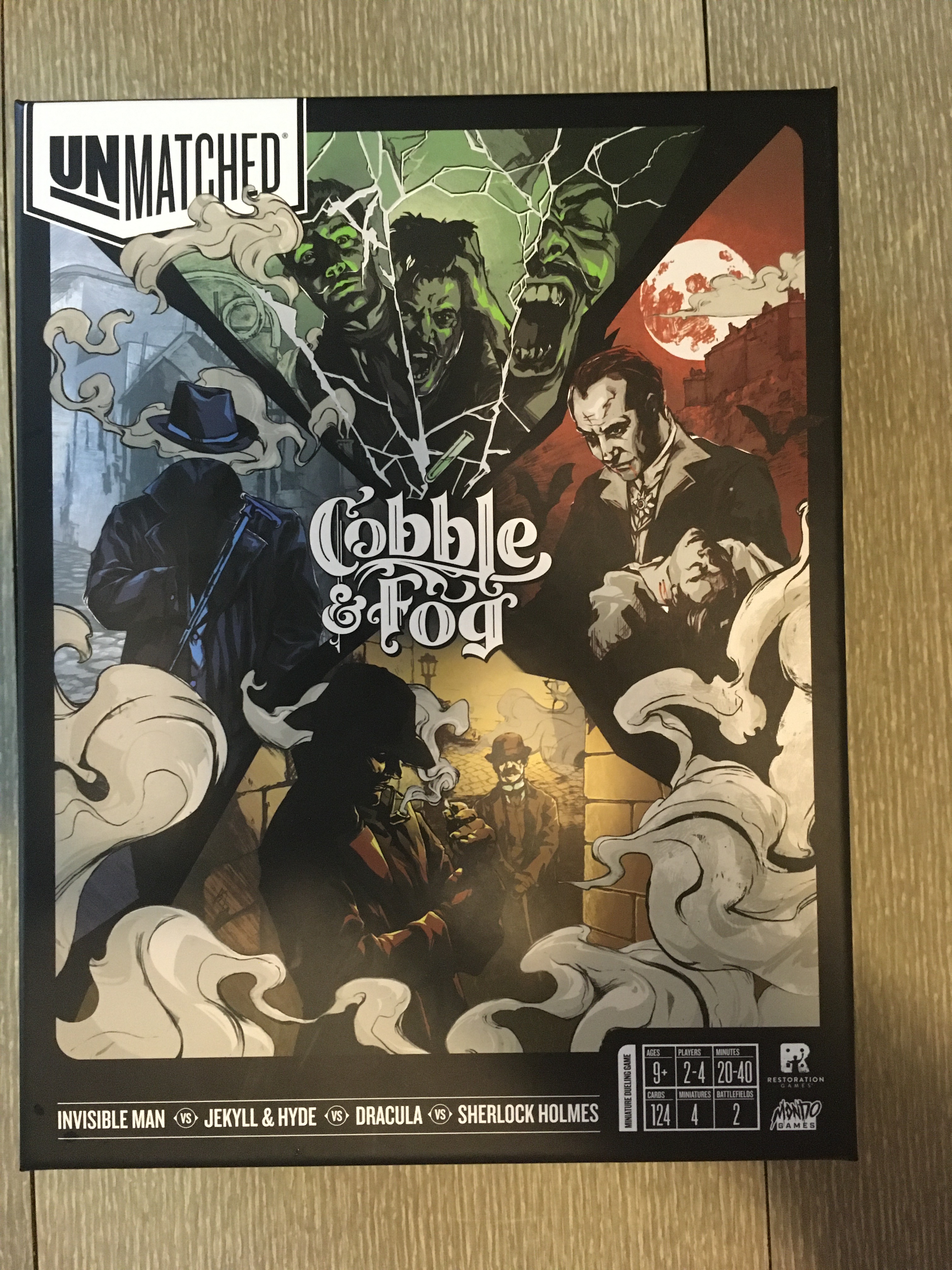
Cobble & Fog (2020) – Sherlock Holmes and Dracula (Petra)
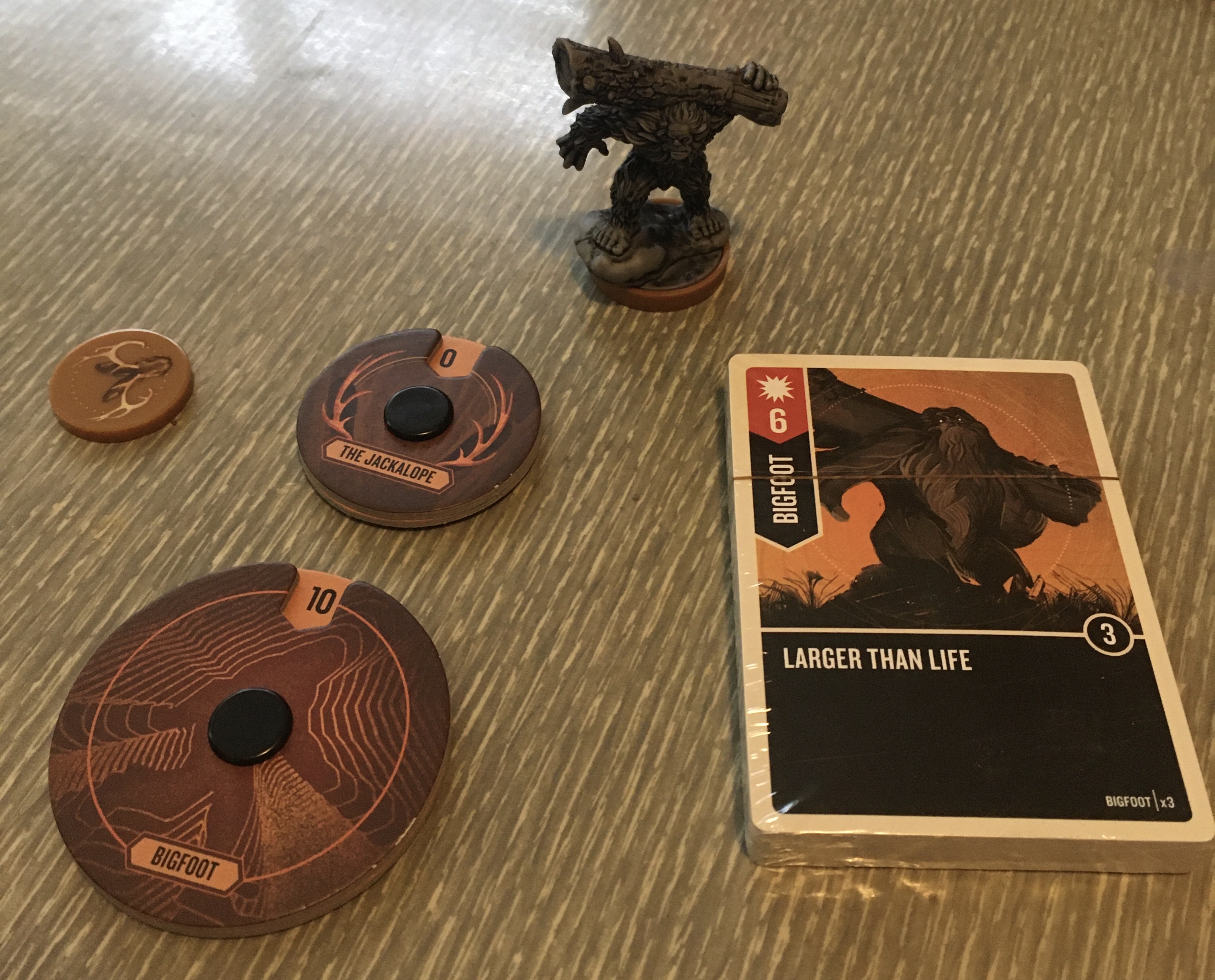
Robin Hood vs. Bigfoot (2019) – Bigfoot (M)

Gist of the game: Choose a battlefield. Choose a character (mythical, literary, or monster. Or Bruce Lee) to fight against another character. The first person to to have their hero defeated (sidekicks don’t affect victory) loses.

Players start the game with a 5-card hand drawn from their character’s deck. On each turn, players must take 2 actions. They can maneuver, scheme, or attack. To maneuver, the player must draw a card, and then has the option of moving up to the number of spaces indicated on their character card. To scheme, players play a scheme card and resolve the action. To attack, players must play an appropriate attack card against an appropriate target (depending on the type of combat their fighter can engage in). The defender may play a defense card, but cards are not revealed until both fighter and defender have chosen their card. Combat is resolved using the specified actions on cards. In case of both players having conditions that need to be resolved at the same time, the defender resolves first. If the attacker deals damage in excess of the defense value, the defender loses that many health points from their targeted fighter. If the defense value exceeds the attack value, the defender takes no combat damage but may still receive damage from card effects. Play continues until all of a player’s fighters, or their hero, have been defeated.

Color commentary: The fact that the different sets are completely interchangeable makes the game delightfully variable, because you can always choose different opponents or a different battlefield. I could also be touchy about this, but I really like that a 2-player game is the default assumption, and that special provisions have to be specified for 3- or 4-player games. Take that, people with gaming groups! I sauntered to an easy victory in the first game between Sherlock Holmes and Bigfoot, but that seems to have been because I inadequately explained to M what cards could be used in defense. Oops. The next two games were closer, but M pulled out the victory in the second game against Sherlock and in the game against Dracula. I really like the Cobble & Fog characters (Sherlock Holmes, Invisible Man, Dracula, and Dr. Jekyll/Mr. Hyde), probably most, but Jurassic Park and a couple of the original characters also seem intriguing. I know M was especially delighted by the Robin Hood vs. Bigfoot set, as those are two of his favorite legendary entities. I’m intrigued by the Bruce Lee set, which feels a little akin to the Kool-Aid Man character in the Funkoverse Strategy Game sets. This game also plays quite quickly with 2 (if not completely in clock time, also in terms of sense of time passing), so makes for a nice chance to play multiple rounds in a reasonable amount of time. If I hadn’t insisted we go for a walk to check on the fall foliage situation around here, we probably would have played several more rounds for a total play time of a couple hours. I do seem to be losing my 24-hour advantage over M, though, so either I’m getting better at explaining game instructions or I haven’t been suggesting the right games to maintain my edge.

Thoughts from M: The figurines that come with each character are excellent, and the Bigfoot figurine is especially delightful. However, choosing between Robin Hood and Bigfoot was one of the hardest choices I have ever made. Petra appeared to give no thought to choosing that notorious cocaine addict Sherlock Holmes. I shall be monitoring her behavior for any changes in the coming days, as it appeared all too easy of a choice for her. I appreciate shorter games that still involve strategy as you can play them several times in quick succession and work out ideas as to what strategies work. (Petra here: but the more times we play the same game, the fewer unplayed games we get to!) Also, beating Petra more than once the first few times we play is an added bonus. She seems to be losing her edge.

Draftosaurus (Ankama, 2019)

Basic details: 2-5 players; 15 minutes; competitive

Dates played: August 15 and September 26, 2020

Gist of the game: You are designing a dinosaur zoo of sorts, and want to place your dinos as advantageously as possible, taking advantage of pairs, one-of-a-kind attractions, and paddocks that have as many similar or dissimilar dinos as possible. The game occurs across 3 rounds (4 rounds in a 2-player game). Players draw a batch of 6 dinos from a blind bag. The current player rolls a die to determine the placement condition for the other players (e.g., on a particular section of the board, in an empty paddock, in a paddock without a T-Rex), and everyone places the dino of their choice on the board and then passes their remaining dinos to the next player (in a 2-player game, each player selects an additional dino to discard before passing them. In a 2-player game, each player plays from some variation of their starting hand twice – on the first and last turns of the round). At the end of the game, the player with the highest score wins.

Color commentary: This is a quick (filler, as the gaming parlance seems to be), fun game, and the differently-shaped dino meeples are a cute touch. (M here: filler games get a bad wrap. The point of a game is to be fun, not long.) Playing a 2-player game may open up more strategies for attempted thwarting than a mutliplayer game would because of the discard choices each player gets to make. I like the limitations placed by the die, but also that putting a dino in the stream on the board is an option so that you do get to place a dino on the board every turn even if you can’t meet any of the placement conditions and earn at least one point for that dino (usually a dinosaur can be strategically placed to earn significantly more than a single point). There is also an alternative board that we haven’t played with yet, but this opens up more potential variability beyond the vagaries of the dinos you end up with in hand each round. Because it’s such a short game, you can also play several rounds in a fairly short period of time and feel like you got your time’s worth — it doesn’t really slog at any point unless someone takes a long time to make a placement decision. This would be a good game if you don’t have a lot of time or if you need something fun but not especially deep or tactical to satisfy an itch to play.

Thoughts from M: This is a really fun game. As with so many we play, I think a good memory would be helpful so you could keep track of what dinos remain as options at any given time to help you plan a longer-term strategy for placement (counterthought from Petra: it is becoming increasingly clear we can never got to Vegas). Also, although having a pen of all the same dinosaur is more valuable than having a pen of only different dinosaurs, it’s always been the case for me that it’s easier to accrue more different dinosaurs than the same dinosaur (possibly because of Petra’s conniving thwarting can only discard so many dinosaurs, usually leaving me with more options than she limited). And the meeples are great!

Villainous (Ravensburger, 2018)

Basic details: 2-6 players (competitive); 40-120 minutes (depending on number of players)

Dates played: July 3, July 4, and July 5, 2020

Expansions played with: Evil Comes Prepared (2019); Wicked to the Core (2019)

Basic details: You are a Disney villain, trying to achieve an objective specific to your character, while possibly also trying to prevent other villains from achieving their objectives, or at least slowing them down.

On each turn, you move your villain to a new location on your 4-location player board and carry out as many of the depicted actions as you want. Actions include gaining power tokens, playing a card, discarded cards, moving a card from a location to an adjacent location, activating a card, vanquishing heroes, and invoking your opponents’ fate cards.

Each villain has 2 decks of cards: a fate deck and a villain deck. The fate deck contains heroes (that may or may not need to be vanquished to achieve your objective), item cards that can be attached to heroes, making them stronger, and effect cards that can otherwise throw wrenches into your plans. The villain deck contains allies, which are slightly less evil villains, items that can be attached to allies, making them stronger, and effects, which usually let you take some kind of additional action that may help you eventually achieve your objective.

When your opponent plays a fate card against you, they draw the top two cards of your fate deck and choose one to play on your board. With few exceptions (like Yzma), they choose where to place any hero they have drawn. When a hero is placed on your board, they block half the actions for that location, and usually can only be removed by being vanquished by allies of equal or greater strength. When a hero is vanquished, any allies involved in the vanquishing are discarded back to the villain deck, while the hero is discarded back to the fate deck.

We blew through 3 games this weekend: Yzma vs. Prince John; Hades vs. Dr. Facilier (The Princess and the Frog), and Scar vs. Jafar.

Color Commentary: This game is fantastic, if for no other reason than they include Yzma, from The Emperor’s New Groove, as one of the villains. TENG is probably my favorite Disney movie, and completely underrated and often forgotten. Plus, her objective is clever: defeat Cuzco using Kronk. But there’s a twist, because Kronk can turn from being an ally to being a hero, the only remedy to which is to use an effect card to place him back in your hand and start the Kronk process over.

I think each package (villain, villain board, fate deck, villain deck, objective, etc.) is pretty clever, and they also create interesting dynamics with how you interact with other players. For instance, in the second game, I played Hades and M played Dr. Facilier, but also took a fate-heavy strategy, which basically made it impossible for me to win. Hades needs to start his turn with 3 titans at Mt. Olympus (far right location). However, titans must be played in the Underworld (far left location), and playing heroes can lock them and make them unmovable without an unlocking card. Also, unlike regular cards, titans can only be moved with special cards, as opposed to with a regular move-a-card action. So by M playing a fate-heavy strategy (he also had 2 locations from which he could invoke fate, and those locations were also pretty useful in general, so he visited them frequently), he could lock and re-lock and sometimes move my titans faster than I could get them to Mt. Olympus, because he had heroes on all my locations and thus half my actions blocked, severely limiting my options each turn. I briefly had 1 titan in Mt. Olympus, at which point he played a hero that let him move a titan, which was then moved onto a location with a hero that automatically locked any titans that landed there. My other 4 titans never made it past Mt. Olympus, and even then, 2 of them were locked and unable to move until I could cycle through and reshuffle my villain deck. I invoked fate less often against Dr. Facilier, and though doing so more often might have slowed M down a bit more, it was just a matter of pace, not possibility.

Compare this with the 3rd game, though, where it would be impossible for M to win if I didn’t use invoke fate cards. Jafar needs the Genie under his control, and the Genie is found in the fate deck. Scar’s objective is also easier to accomplish if other players invoke fate, although Scar at least has cards that let him look through the fate deck himself.

Thoughts from M: In the first game, I was Prince John, who had the pretty simple objective of accruing 20 power tokens. This seemed too easy, though, so I fiddled around with other strategies for a bit, and Petra won. In the second game, I was more aggressive, and decided from the beginning to play a fate-heavy strategy, just to see what happened. In the 3rd game, I couldn’t really figure out a best strategy and fate wasn’t thwarting in the same way against Scar as it was against Hades, as Scar needs to vanquish heroes to achieve his objective.  (Also, this game is evil as it had me fighting again Robin Hood, but then again monarchs are made up of the better families amongst us and do deserve to rule.)

In general, I think mixed strategies probably won’t work in 1 on 1 games as well as they would against more opponents, so against a single other opponent, I think it’s best to decide on a strategy early on and sticking with it and invoking it consistently are key. That said, it does seem to be a flaw in the game that fate (either invoked or not invoked) can make it functionally or actually impossible for a villain to achieve their objectives, because then players could just lock another player out, which definitely diminishes the enjoyment that player would get out of the game.